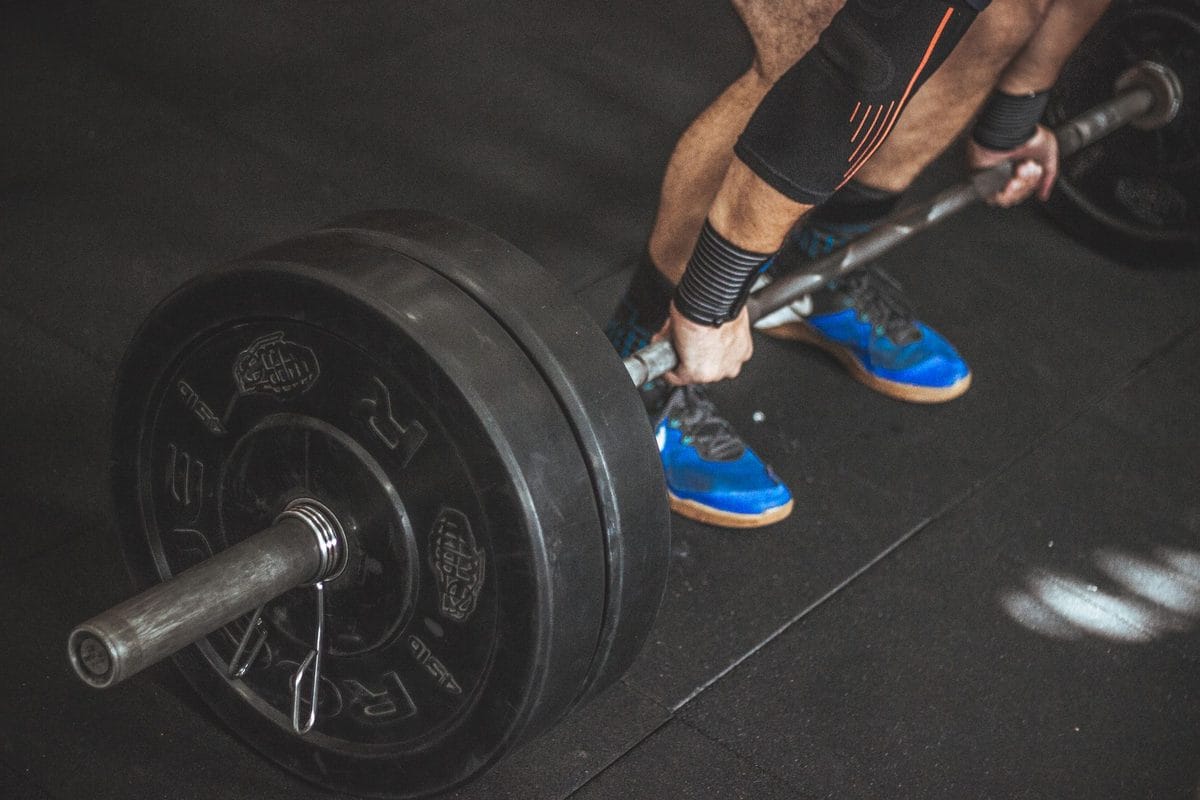
Your grip is almost certainly the weakest link in your deadlift, and you've probably never trained it directly. Most men hit a wall around 140–160 kg where the bar starts rolling out of their fingers before their back or legs give out, then assume they've maxed out. They haven't. The hands quit first, the brain reads that as failure, and the legs that could've pulled another 20 kg never get the chance.
There's a reason grip matters beyond the gym. Large studies tracking tens of thousands of adults have found grip strength to be one of the cleaner predictors of all-cause mortality in middle age — stronger, in some datasets, than blood pressure. Nobody's claiming a stronger grip makes you live longer on its own; it's a marker of overall muscular health and the kind of physical robustness that ages well. But it's a marker you can directly improve, which is more than you can say for most numbers on a longevity chart.
The three kinds of grip, and why you need all three
Crushing grip is what a handshake or a gripper trains — the fingers closing into the palm. Supporting grip is what holds a heavy bar or a loaded farmer's walk for time, and it's the one that fails in your deadlift. Pinch grip is the thumb working against the fingers, the weakest and most neglected of the three. Crushers build the grip that looks impressive; supporting grip builds the grip that actually carries over to your lifting.
If you only train one, train supporting grip, because that's the one limiting your pulls. The simplest way to do it costs nothing: stop using straps for your warm-up and lighter deadlift sets. Straps have their place on a true one-rep-max attempt, but if you're strapping up for triples at 70%, you're training your back while letting your grip atrophy.
What actually works
- Farmer's walks: grab the heaviest dumbbells or a trap bar you can hold, walk 30–40 metres, repeat for 4–5 rounds. Nothing builds supporting grip and a thick midsection faster.
- Dead hangs: hang from a pull-up bar for time. Work up from 30 seconds to two minutes total across sets. It also decompresses a spine that's been sitting at a desk all day.
- Captains of Crush grippers: the Trainer and No.1 from Iron Mind are the standard for crushing grip — genuinely hard, genuinely well made, around £20 each.
- Plate pinches — hold two 10 kg plates smooth-side-out between thumb and fingers for as long as you can, which will be embarrassingly short the first time and that's the whole point.
How to program it without wrecking your recovery
Grip recovers fast because the forearm muscles are small and well supplied with blood, so you can train it more often than you'd train your legs. Twice or three times a week is fine. The mistake men make is bolting forty minutes of grip work onto an already brutal session, then wondering why their pressing stalls — the forearm fatigue bleeds into everything that needs a stable wrist.
Keep it short and keep it at the end. Five to ten minutes after your main lifts, two or three times a week. A simple template: heavy farmer's walks on your lower-body day, dead hangs on your pulling day, and grippers whenever you've got two minutes spare and a gripper within reach of the sofa. That last one matters more than it sounds — grip responds well to frequent small doses, and a gripper by the TV gets used in a way that a gripper in a gym bag never does.
The over-35 wrinkle
Here's the part the younger lifting crowd glosses over. Past 35, the connective tissue in your hands and elbows takes longer to adapt than the muscle, and the most common grip injury isn't a torn muscle — it's a flared-up medial epicondyle, the golfer's-elbow tendon on the inside of the elbow. Ramp the volume slowly. If the inside of your elbow starts aching during pull-ups or curls, that's the warning, and the fix is to back off the gripper work for a fortnight, not to push through it.
One caveat worth being honest about: if your goal is purely a bigger deadlift on competition day, straps and a mixed grip will get more weight off the floor than raw grip ever will, and that's legitimate. Grip training is for the 95% of your lifting that isn't a max attempt — the everyday strength that makes a suitcase feel light and a jar lid pointless to resist.
Pick up the heaviest dumbbells in your gym and walk to the far wall and back. If your hands open before your legs tire, you've found the link that's been holding back every pull you've done this year.