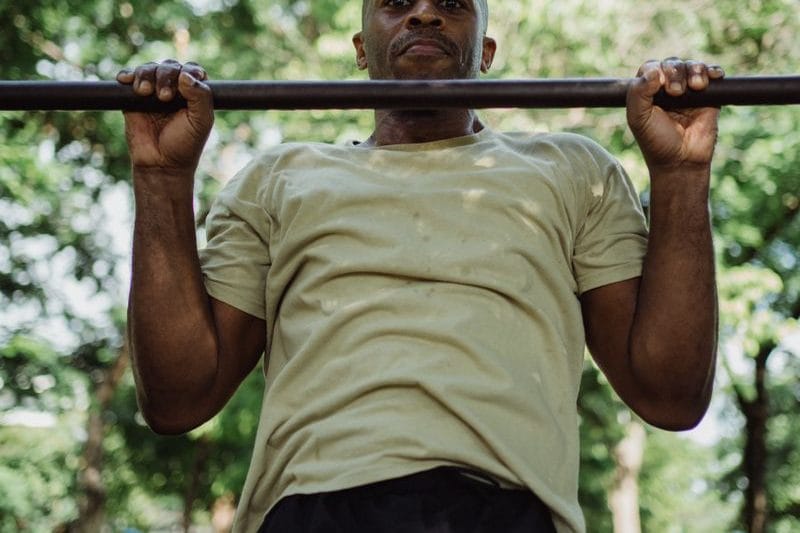
Walk into any PureGym or The Gym Group on a Monday evening and watch the deadlift platform. Plenty of men there can pull 140kg off the floor for a single rep — until their hands open halfway through the lift and the bar rolls out of their fingers before their back ever reaches its limit. The lats didn't fail. The glutes didn't fail. The hands did. Nobody programmes for that, and it's costing lifters kilos on the bar they've technically already earned.
The forearms are the weakest link nobody trains directly
Grip strength is one of the few qualities in the gym that gets used in almost every compound lift — deadlifts, rows, pull-ups, farmer's carries, even a heavy bench press if you're gripping the bar hard enough to brace properly — yet almost nobody trains it as its own quality. You'll find a dedicated hamstring day, a dedicated shoulder day, sometimes an entire session built around arms. Forearms get whatever's left over, usually nothing, because the assumption is that grip takes care of itself as a by-product of everything else. It doesn't. Grip strength plateaus faster than back strength does, which means somewhere around an 8-week block into a serious pulling programme, your hands become the limiting factor on lifts they have no business limiting.
This shows up first on deadlifts. A double overhand grip — both palms facing you — starts slipping on barbell weights that your posterior chain could otherwise move without much trouble, which is exactly why so many lifters switch to a mixed grip (one palm forward, one back) or a hook grip (thumb trapped under the fingers) the moment the bar gets heavy. Both work. Both also come with trade-offs: mixed grip creates asymmetric loading through the biceps and shoulders over time, and hook grip is genuinely painful until your thumbs toughen up, which takes weeks, not one session. Straps solve the slipping problem but only for lifts where grip isn't the point — pulling straps on every set of deadlifts just outsources the exact adaptation you're trying to build.
What the research actually says
The most cited data point here isn't from a strength-and-conditioning journal — it's from cardiology. The PURE study, led by Darryl Leong and published in The Lancet in 2015, tracked roughly 140,000 adults across 17 countries and measured grip strength with a handheld dynamometer at baseline. The researchers found that grip strength was a stronger predictor of all-cause mortality and cardiovascular death over the following years than systolic blood pressure was. Each 5kg drop in grip strength tracked with a meaningfully higher risk of dying from any cause during the study period. Grip strength wasn't causing the risk directly — it's a marker of overall muscle mass, nervous system function and general physical condition — but the correlation was strong enough that grip testing has since shown up in geriatric assessments and cardiac rehab screening protocols well beyond the original study.
None of that means squeezing a gripper adds years to your life on its own. What it does mean is that grip strength is a decent proxy for how much muscle you're carrying and how well your nervous system is firing, which is precisely why it's worth tracking and training rather than leaving to chance.
Four ways to actually build it
Training grip properly means attacking it from more than one angle — crush strength, pinch strength, and support (or "hold") strength are three separate qualities, and most lifters only ever develop one of them by accident.
- Dead hangs. Hang from a pull-up bar for time, working up toward 60-90 seconds per set across 2-3 sets. This builds support strength directly and doubles as shoulder decompression after a heavy pressing session.
- Farmer's carries. Pick up a pair of heavy dumbbells or loaded farmer's handles — most decent commercial gyms have a strongman corner with these now — and walk for 20-40 metres. Load heavier than feels sensible; this is one of the few exercises where near-maximal weight for short distances beats moderate weight for longer ones.
- Plate pinches. Pinch two 10kg or 15kg plates together, smooth sides out, and hold for time. Brutal on pinch strength specifically, which barbell work never touches.
- Thick-bar work. Wrap Fat Gripz around a barbell or dumbbell handle, or use a thick-bar attachment if your gym has one, and do rows or curls at reduced weight. The wider diameter forces the hand to work far harder to close around the bar than a standard 28mm barbell ever does.
Add two of these to the end of a pull day, twice a week, and you'll notice the carryover inside a month — not because the exercises themselves are glamorous, but because a stronger grip means every pulling movement in your programme stops leaking force through your fingers before your back gets a proper stimulus.
Where this actually pays off
Pull-ups are the clearest example. Most men who stall on pull-up progressions blame lat strength when the actual bottleneck is that their forearms give out at rep six, well before their back does. Building support strength through dead hangs and farmer's carries fixes this faster than adding more pull-up volume does, because you're addressing the actual limiting variable instead of hammering the one that isn't failing.
Deadlifts respond the same way, though more slowly — grip adaptations from carries and hangs take four to six weeks to show up as a heavier top-end double-overhand pull, which is longer than most people give it before switching back to straps out of impatience. Stick with it. A gripper from a brand like IronMind's Captains of Crush is worth adding to a gym bag too, not because it replaces carries or hangs, but because it's genuinely portable — five sets of five max-effort closes fit into a commute or a coffee break, and crush strength is the one grip quality that carries over to almost every daily task outside the gym as well, from opening a stiff jar to carrying shopping bags in one trip instead of two.
Tendons adapt slower than muscle does
One thing that catches lifters out: the muscle bellies in your forearm respond to training on a normal 4-6 week timeline, but the tendons and connective tissue running from your fingers up through your wrist adapt far more slowly, sometimes over several months. That's why grip training that ramps up too fast produces golfer's elbow or a stubborn wrist ache rather than strength gains — the muscle got stronger before the tendon caught up, and the tendon is what actually tears. Progress load on pinches and thick-bar work in small increments, not the same 5-10% weekly jumps you might use on a barbell squat.
Diet plays a role here too, and it's worth getting right rather than leaving to chance. Adequate daily protein — most lifters training seriously do fine around 1.6-2.2g per kilogram of bodyweight — supports connective tissue repair the same way it supports muscle repair. Some research out of Keith Baar's lab at UC Davis has looked at whether taking vitamin C alongside a gelatin or collagen source shortly before connective-tissue-heavy training sessions boosts collagen synthesis markers; the field is still young and the effect size varies between studies, but it's a low-cost addition worth testing on yourself over a training block rather than something to build an entire supplement stack around.
The honest caveat
Grip work fixes grip failure. Nothing else.
It isn't a shortcut around weak lats or a lazy lower back — if your deadlift is stalling because your hips shoot up first or your upper back rounds under load, no amount of farmer's carries will fix a technique fault. Grip work fixes grip failure specifically, and conflating the two just wastes training time that would be better spent filming your setup and checking your bar path. Be honest about which one you're actually dealing with before you add another exercise to an already busy programme.
That said, for most lifters who've been training for more than a year, grip genuinely is the neglected 20% doing 80% of the damage to their pulling numbers. Add the carries. Add the hangs. Track your numbers on both the same way you track your squat and bench, and stop treating your hands as an afterthought that just happens to be attached to the bar.