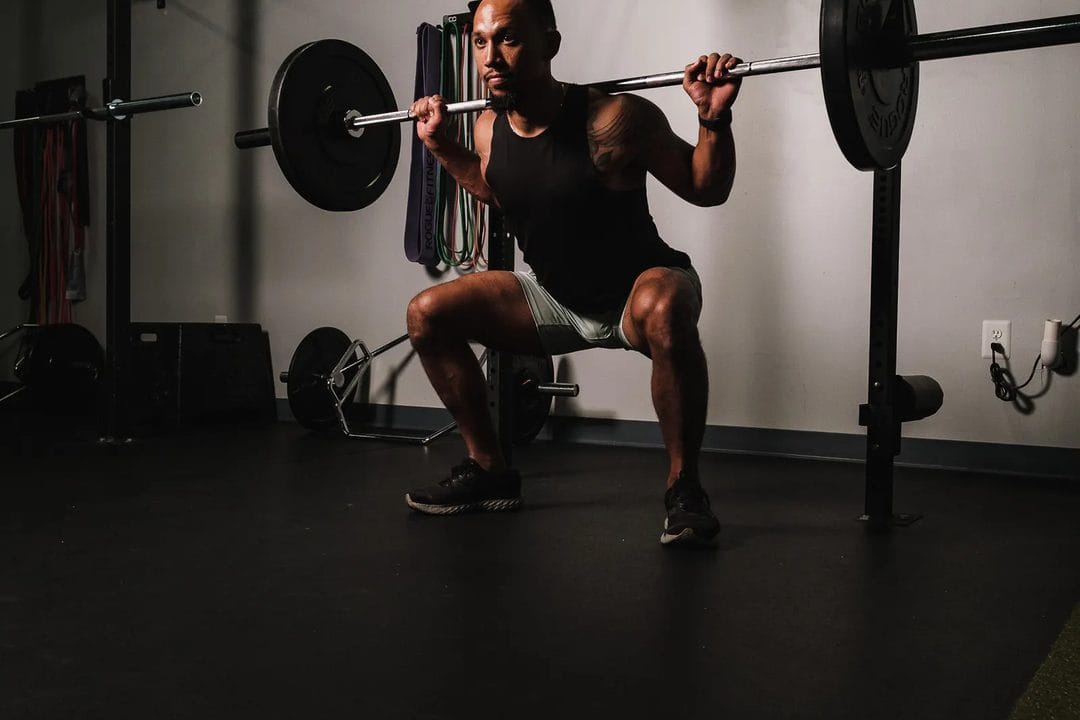
You've stretched your hips for six weeks straight, and the bar still stalls two inches above parallel. Your knees cave slightly at the bottom, your heels want to lift, and your coach — or the mirror, more likely — keeps telling you to "open up the hips." So you foam-roll the glutes, you do pigeon stretch after every session, and nothing changes. That's because for most men over 35, the thing actually stopping the squat isn't the hip at all. It's the ankle.
The Hip-Mobility Excuse Doesn't Hold Up
It's an easy story to believe, and almost everyone believes it.
Hip mobility gets blamed first, mostly because it's the joint every gym-goer has already heard of. Physios talk about hip flexor tightness from sitting at a desk all day, and that fits neatly with fifteen years behind a laptop. Gym culture reinforces it too — half the mobility content aimed at men over 35 is hip openers, 90/90 stretches, and couch stretches, because hips sound like the grown-up, desk-job explanation. But watch what actually happens when a stiff squatter fails to hit depth: the torso pitches forward, the heels rise off the floor, and the knees drift inward to compensate for a shin that can't tilt any further forward. None of that is a hip signature. That's ankle dorsiflexion running out of range before the hip ever gets tested, and once you know what to look for, you'll see it in half the men squatting around you on any given Monday.
Dorsiflexion is simply how far your shin can travel forward over your foot while your heel stays planted. In a proper squat, the knee needs to track forward well past the toes at the bottom, and that requires roughly 35–40 degrees of ankle dorsiflexion under load. Years of wearing cushioned trainers with a raised heel, plus a desk job that never asks the calf to lengthen, leave most men with somewhere between 15 and 25 degrees. The hip has plenty of room left to work with. The ankle ran out first, and the rest of the body improvises around it.
The Knee-to-Wall Test Tells You in Thirty Seconds
You don't need a physio appointment to find out which joint is actually limiting you. Kneel side-on to a wall, barefoot, with your big toe about ten centimetres from the skirting board. Drive your knee forward over your toes without letting the heel lift. If your knee can touch the wall from that distance, your ankle is fine and the depth problem lies elsewhere — hip, thoracic spine, or simply technique. If your heel pops up before the knee gets close, or you have to shift the whole foot forward to make contact, that's your answer.
Run the test on both sides. Asymmetry between your left and right ankle is common — an old sprain, a stiffer side from favouring one leg — and it shows up in the squat as one knee caving before the other, or the bar drifting off centre on the way up. Most men who fail this test on one side blame their "weak leg" for years without ever checking the ankle underneath it.
Heel Elevation Fixes It Faster Than Stretching Ever Will
Here's the part that surprises people: you don't have to fix your ankle mobility before you can squat properly. You can elevate the heel and let the shoe do the job the ankle can't do yet. Weightlifting shoes with a solid, non-compressible heel — usually 0.75 to 1 inch of raised, hard wedge — reduce how much dorsiflexion the ankle needs to find, because the heel is already partway to where the ankle would have had to bend.
Buy a proper pair rather than improvising forever. The Adidas Adipower and the Reebok Legacy Lifter are the two you'll see most often in UK commercial gyms, both sitting around £110–£160, and either will outlast years of training. If that's more than you want to spend before you're sure this is your problem, a 5–10kg plate under each heel or a cheap 2.5cm wooden wedge does the same job for a training session — it's not elegant, but it works, and plenty of serious lifters still use plates for a warm-up set even after they own proper shoes.
Don't confuse this with a permanent fix. Heel elevation is a workaround, not a cure — it lets you train heavy and pain-free squats while you build real ankle range on the side, and most lifters end up keeping the shoes anyway because a raised heel also shifts more of the work onto the quads, which most men over 35 are happy to have.
Ankle Mobility Work That Actually Moves the Needle
Static calf stretching against a wall barely touches this problem, because it doesn't load the ankle the way a squat does. What works is loaded, weight-bearing mobility — drills that ask the ankle to bend under real body weight, in the same pattern the squat demands.
- Weighted ankle rocks: hold a light dumbbell at your chest, drop into a half-kneeling lunge with the front foot flat, and rock your knee forward and back over the toes for 10–12 reps each side, every training day if you can manage it.
- Wall dorsiflexion holds: from the knee-to-wall test position, hold the end range for 30–45 seconds under light pressure, three sets per side.
- Banded ankle distraction: loop a resistance band around the front of the ankle joint, anchor it low, and drive the knee forward against the band's pull for 15 reps — this one's uncomfortable the first few times, and that's normal.
- Finish sessions with a few sets of barefoot goblet squats and no heel elevation at all — it forces the ankle to work through whatever range it currently has, and that range tends to improve on its own once it's asked to do the job regularly.
None of that list is exhaustive — plenty of physios will add calf raises off a step, tibialis rocks, or a foam roller under the calf, and any of those can help too. What matters more than the exact drill selection is frequency. Four weeks of consistent work on these, three or four sessions a week, is usually enough to see a genuine change on the knee-to-wall test. That's not a full transformation and nobody should expect one — years of stiff ankles don't reverse in a month — but it's enough that the heel-elevated shoes start feeling like less of a crutch and more of an option you keep because you like the extra quad work, not because you need it to hit depth at all.
Stance Width and Foot Angle Are Doing More Damage Than You Think
A stance that's too narrow with the toes pointed straight ahead asks for more ankle dorsiflexion than almost anyone has, elevated heels or not. Widen the stance to roughly shoulder-width or slightly beyond, and turn the toes out somewhere between 15 and 30 degrees. This isn't a personal preference thing to fiddle with endlessly — it's mechanics. A wider, slightly turned-out stance lets the hip externally rotate to create depth instead of asking the ankle to supply all of it, and for most men over 35 with average hip anatomy, that's simply the more efficient way to squat.
Go too wide, though, and you'll shift the load onto the adductors and lose tightness through the midline — you'll know you've overdone it if the bar starts drifting forward off your shoulders on the way down. Somewhere in the middle is right for almost everyone, and the only way to find your number is to test a few widths across a few sessions and watch where the knees track cleanly over the toes without straining.
The Box Squat as a Diagnostic, Not Just an Accessory Lift
Powerlifters use the box squat to build strength out of the bottom position, but it's also a useful diagnostic tool most men over 35 never think to use it for. Set a box at a height where you can sit back onto it with a flat foot and an upright-ish torso, without the heels lifting or the knees collapsing inward. If that height is well above parallel, you now have hard proof of exactly how much range you've actually got today — not what you think you should have, not what your training partner has, but your number. A lot of men are surprised by how high that box needs to be the first time they set it honestly, because the free squat lets you cheat depth in ways a box won't allow. Any adjustable bench or a stack of bumper plates works fine for this — you don't need a purpose-built lifting box, just something solid enough to sit on and get back up from under load. Do this once at the start of a mobility block and once every few weeks after, and you'll have an actual number to compare instead of a gut feeling about whether the ankle work is doing anything.
Lower the box by an inch every couple of weeks as your ankle mobility work takes hold, and you've got a built-in progress tracker that doesn't depend on guessing. This beats chasing depth on a free squat and hoping for the best, because a box removes the guesswork about where "good enough" actually is on any given day. Once you can sit onto a box at or just below parallel with a flat foot and no knee collapse, drop the box altogether and let the free squat catch up — by then it usually does, within a session or two, because the range was there the whole time and the box just proved it.
When It Really Is the Hips
None of this means hip mobility never matters — it's just rarer as the actual limiter than gym folklore suggests. If you pass the knee-to-wall test cleanly on both sides but still can't hit depth without your lower back rounding hard at the bottom, that's a different pattern altogether, and it usually points to the hips or the thoracic spine rather than the ankle. Deep hip flexor tightness from years of sitting can genuinely restrict how far the femur travels into the hip socket, and no amount of ankle work will touch that.
The test still matters here, because it tells you which problem you're actually solving. Spending another six months stretching hips that were never the issue is how men end up convinced their body "just isn't built for squatting" — when the honest answer was a £120 pair of shoes and four weeks of banded ankle work.